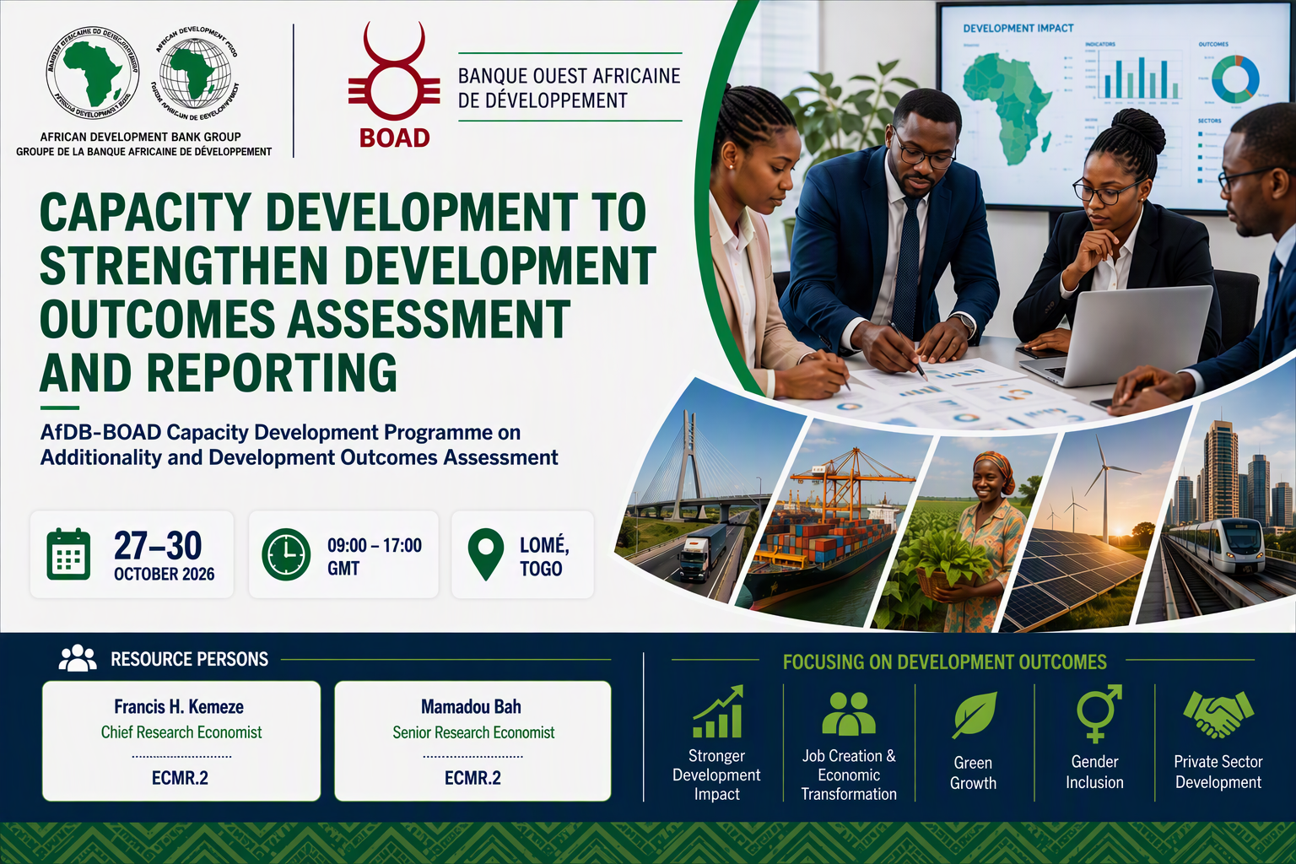
Introduction to the AfDB–BOAD Capacity Development Training on Additionality and Development Outcomes Assessment (ADOA)
Background
The African Development Bank Group (AfDB) is supporting the West African Development Bank (BOAD) through a four-day capacity development and knowledge-sharing workshop aimed at strengthening BOAD’s institutional capacity to assess, monitor, and report the development outcomes and additionality of its operations. The training responds to a request from BOAD for technical support in enhancing its development impact assessment capabilities and strengthening its results measurement and reporting systems. The workshop will take place in Lomé, Togo, from 27 to 30 October 2026.
The training brings together staff from BOAD’s Research, Investment, SME Finance, Portfolio Management, Credit, Risk, and Compliance Departments, reflecting the cross-functional nature of development impact assessment and results management.
Training Rationale
As development finance institutions increasingly focus on measurable impact, there is a growing need for robust frameworks that can demonstrate how investments contribute to economic transformation, private sector development, job creation, gender inclusion, climate resilience, and broader development outcomes. To address this challenge, the AfDB has developed the Additionality and Development Outcomes Assessment (ADOA) Framework, which serves as the Bank’s primary tool for assessing the expected development impact and additionality of non-sovereign operations.
By strengthening BOAD’s understanding and application of development outcomes assessment methodologies, the training will support the institution in integrating impact considerations more systematically into its investment decision-making processes and enhancing accountability for development results.
Objectives of the Workshop
The overall objective of the training is to strengthen BOAD’s capacity in the assessment, monitoring, and reporting of development outcomes. Specifically, participants will:
- Gain a comprehensive understanding of the AfDB’s Results Measurement and Reporting Framework and the ADOA 3.0 Framework.
- Develop the skills required to assess project additionality and expected development outcomes.
- Learn methodologies for rating and scoring development impact.
- Understand approaches for assessing development context and likelihood of achieving results.
- Strengthen capacity in due diligence, data collection, monitoring, supervision, and reporting of development outcomes throughout the project cycle.
- Acquire practical hands-on experience through the application of the ADOA methodology to real-world investment case studies.
Training Approach
The workshop combines conceptual learning with practical application. The first two days focus on the foundations of development outcomes assessment, including ADOA concepts, principles, indicators, benchmarking methodologies, likelihood assessments, and reporting frameworks. The final two days are dedicated to intensive case-study exercises that guide participants through the complete ADOA process, from project analysis and additionality assessment to development outcomes evaluation, scoring, and reporting.
Participants will work through three comprehensive case studies covering the finance, industry, and infrastructure sectors, enabling them to apply the methodology in realistic operational contexts and strengthen their analytical and decision-making skills.
Expected Outcomes
Upon completion of the training, participants will be equipped with the knowledge, tools, and practical experience necessary to assess and report development outcomes more effectively. The workshop is expected to support BOAD in establishing stronger institutional systems for results measurement and impact reporting, aligned with international development finance best practices. It will also generate recommendations and follow-up actions to support the operationalization of a robust development outcomes framework within BOAD.
Ultimately, the training will contribute to strengthening BOAD’s ability to demonstrate development impact, enhance its strategic value proposition within the region, and ensure that development outcomes remain central to its investment and financing decisions.